


White paper
Gartner® Rethink Enterprise Search to Power AI Assistants and Agents
Sinequa Mentioned in the Gartner® Hype Cycle™ for Discrete Manufacturing Technologies, 2025.

About This Gartner® Research Note
Rethink Enterprise Search to Power AI Assistants and Agents is a Gartner® research note by analyst Stephen Emmott, published on April 9, 2025. It argues that the enterprise search architectures most organizations rely on today are structurally insufficient to support the next generation of AI assistants and autonomous agents — and that organizations must make deliberate, foundational changes to their search infrastructure to unlock AI’s full potential at work.
Sinequa is cited in the report under the “Search & Synthesis as Apps” vendor category, alongside other providers active in this space.
What Is This Gartner® Report About?
The central thesis of Emmott’s research note is both clear and strategically important: AI assistants and agents are only as good as the information they can reliably retrieve and reason over. If the underlying enterprise search infrastructure is fragmented, keyword-dependent, or disconnected from the full breadth of organizational knowledge, then AI assistants will produce incomplete, unreliable, or confidently wrong answers — regardless of how capable the underlying language model is.
This is not a niche concern. As organizations deploy AI assistants and agentic workflows at scale, the quality of enterprise search becomes a strategic bottleneck. The report identifies the specific gaps in legacy enterprise search that create this bottleneck and outlines what a modern, AI-ready search foundation must look like.
Why Legacy Enterprise Search Falls Short for AI Agents
Gartner’s argument in this report reflects a structural limitation that most enterprise AI deployments encounter in practice. Traditional enterprise search was designed for a specific task: help a human user find a document by typing keywords. That task has a generous margin for imprecision — a human can scan ten results, recognize what’s relevant, and synthesize the answer themselves.
AI agents operate differently. When an AI agent needs to retrieve information to complete a task, it cannot browse through a results list and apply judgment. It needs enterprise search to return the right content, in the right context, with the right grounding — on the first attempt. An AI agent that retrieves the wrong document, misses a critical update, or fails to surface a relevant policy record will propagate that error into every downstream action it takes.
This places entirely new demands on enterprise search infrastructure across five dimensions:
- Completeness of coverage. AI agents need access to the full scope of enterprise knowledge — not just the documents in a single repository, but content across every system an employee might consult: PLM platforms, SharePoint, Salesforce, ServiceNow, Confluence, email, and dozens more. A search layer that covers 60% of enterprise content is sufficient for human search; for an AI agent, it is a reliability failure.
- Semantic precision at query time. AI agents generate queries in natural language, often with nuanced, multi-part information needs. Legacy keyword-based search cannot reliably satisfy these queries. Enterprise search for AI agents must understand the meaning of the query — not just match its terms — and retrieve content that is semantically relevant to the underlying information need.
- Real-time freshness and accuracy. AI agents act on what they find. If enterprise search returns stale content — an outdated policy, a superseded engineering specification, a closed support ticket — the agent will act on incorrect information. AI-ready enterprise search requires continuous, near-real-time indexing of all connected content sources.
- Access control enforcement at retrieval time. AI agents frequently execute queries on behalf of users with different permission levels. Enterprise search must enforce the access controls of every connected system at query time — ensuring that an agent never surfaces content the requesting user is not authorized to see. This is not just a security requirement; it is a governance and compliance imperative.
- Source attribution and explainability. For AI assistants and agents to be trusted in enterprise contexts, every answer they produce must be traceable to a verified source. Enterprise search must not only retrieve the right content but also return it in a form that allows the AI system to cite, attribute, and display the original source — enabling users to verify and audit AI-generated outputs.
What Is “Search & Synthesis as Apps”? — Gartner’s Vendor Category
The Gartner research note organizes the vendor landscape for AI-ready enterprise search into categories based on how vendors approach the combination of retrieval and synthesis. “Search & Synthesis as Apps” refers to platforms that deliver search and AI-powered answer synthesis as an integrated, deployable application — not as raw infrastructure components that must be assembled by development teams.
This category reflects a specific buyer need: organizations that want the capabilities of modern AI search — semantic retrieval, RAG-powered answer generation, connectors to enterprise systems, access control enforcement — delivered as a production-ready platform, rather than a set of APIs and models to be self-integrated.
Sinequa’s citation in this category reflects its position as a platform that delivers enterprise AI search end-to-end: from the connector ecosystem and hybrid retrieval engine through to the RAG pipeline, AI assistant interface, and enterprise AI agent framework — without requiring the customer to assemble these components from scratch.
What the Report Recommends for Enterprise Technology Leaders
The Gartner research note provides three categories of actionable guidance for organizations building AI assistants and agents on top of enterprise search infrastructure:
- Assess the current state of your enterprise search foundation. Before deploying AI assistants or agents at scale, organizations should audit the coverage, freshness, semantic capability, and access control enforcement of their existing enterprise search layer. Most legacy search deployments will have significant gaps in one or more of these dimensions — gaps that will directly limit the reliability of any AI assistant or agent built on top of them.
- Invest in AI-ready retrieval architecture. The report recommends that organizations move toward hybrid retrieval architectures that combine semantic vector search with keyword search and structured data retrieval — and that these architectures be capable of real-time indexing across all major enterprise content sources. Organizations that defer this infrastructure investment will find their AI assistant deployments underperforming relative to expectations.
- Treat search as strategic AI infrastructure, not a commodity tool. One of the report’s most important strategic arguments is that enterprise search should no longer be treated as a utility — a background capability that users either find acceptable or work around. As the retrieval layer for AI agents and assistants, enterprise search becomes a core determinant of AI quality across the organization. It deserves the same strategic investment and executive attention as the AI models themselves.
How Sinequa Addresses the Requirements Gartner Identifies
Sinequa’s platform is architected specifically to address the enterprise search requirements that Gartner identifies as prerequisites for reliable AI assistants and agents:
- Universal enterprise connectivity. Sinequa connects to over 200 enterprise content systems through a pre-built connector ecosystem — ensuring AI agents have access to the full breadth of organizational knowledge, not just a subset of it. Connectors maintain real-time or near-real-time synchronization, so agents are always working with current content.
- Hybrid retrieval for AI-grade precision. Sinequa’s retrieval engine combines neural semantic search, keyword search, and structured data retrieval in a unified pipeline — delivering the semantic understanding AI agents require without sacrificing the precision that enterprise content demands.
- RAG with access-control-aware retrieval. Sinequa’s retrieval-augmented generation architecture enforces the access controls of every connected system at query time. AI assistants and agents built on Sinequa never surface content outside a user’s authorized scope — regardless of how the query is formulated.
- Source attribution by design. Every AI-generated answer from Sinequa’s platform is accompanied by source citations drawn from the retrieved enterprise content — enabling full auditability and user verification of AI outputs.
- Enterprise AI agents for autonomous workflows. Sinequa’s agentic AI framework extends beyond search and Q&A to support multi-step autonomous workflows — giving organizations a path from AI-assisted discovery to AI-driven action, on the foundation of trusted enterprise retrieval.
artner® Rethink Enterprise Search to Power AI Assistants and Agents. By Analyst: Stephen Emmott, 9 April 2025.
Gartner does not endorse any vendor, product or service depicted in its research publications, and does not advise technology users to select only those vendors with the highest ratings or other designation. Gartner research publications consist of the opinions of Gartner’s research organization and should not be construed as statements of fact. Gartner disclaims all warranties, expressed or implied, with respect to this research, including any warranties of merchantability or fitness for a particular purpose.
GARTNER is a registered trademark of Gartner, Inc. and/or its affiliates in the U.S. and internationally and are used herein with permission. All rights reserved.
This graphic was published by Gartner, Inc. as part of a larger research document and should be evaluated in the context of the entire document. The Gartner document is available upon request from Sinequa.
More white papers
-
 White paper October 12, 2026
A Leader’s Guide To Operational AI in Action
Read more -
 White paper October 8, 2026
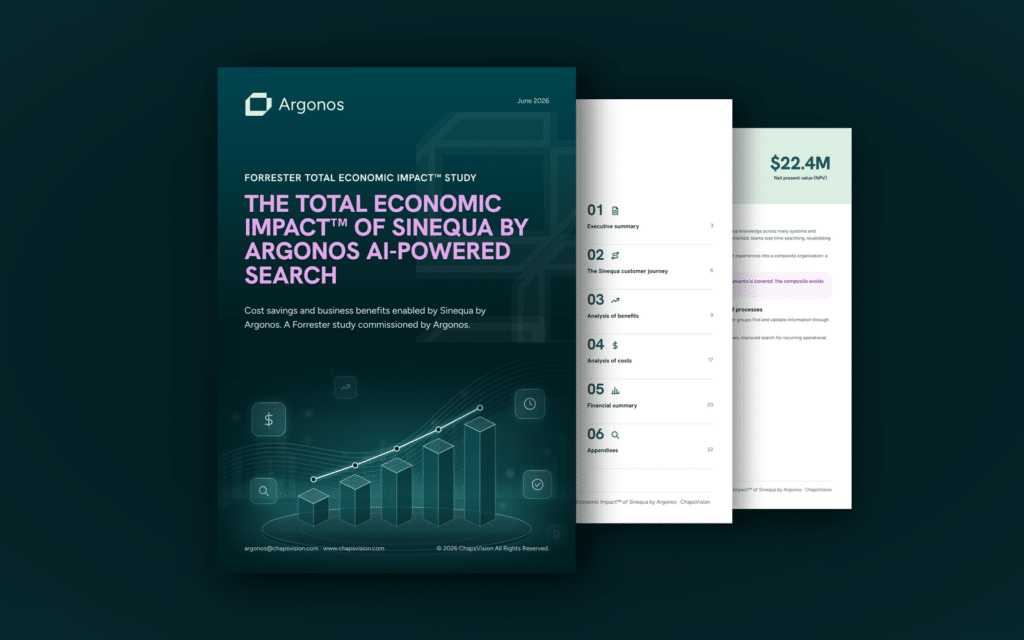
The Forrester TEI™ Study on Sinequa AI-Powered Search
Read more -
 White paper September 26, 2026
The State of Enterprise Agentic AI in 2026
Read more