White paper
The State of Enterprise Agentic AI in 2026
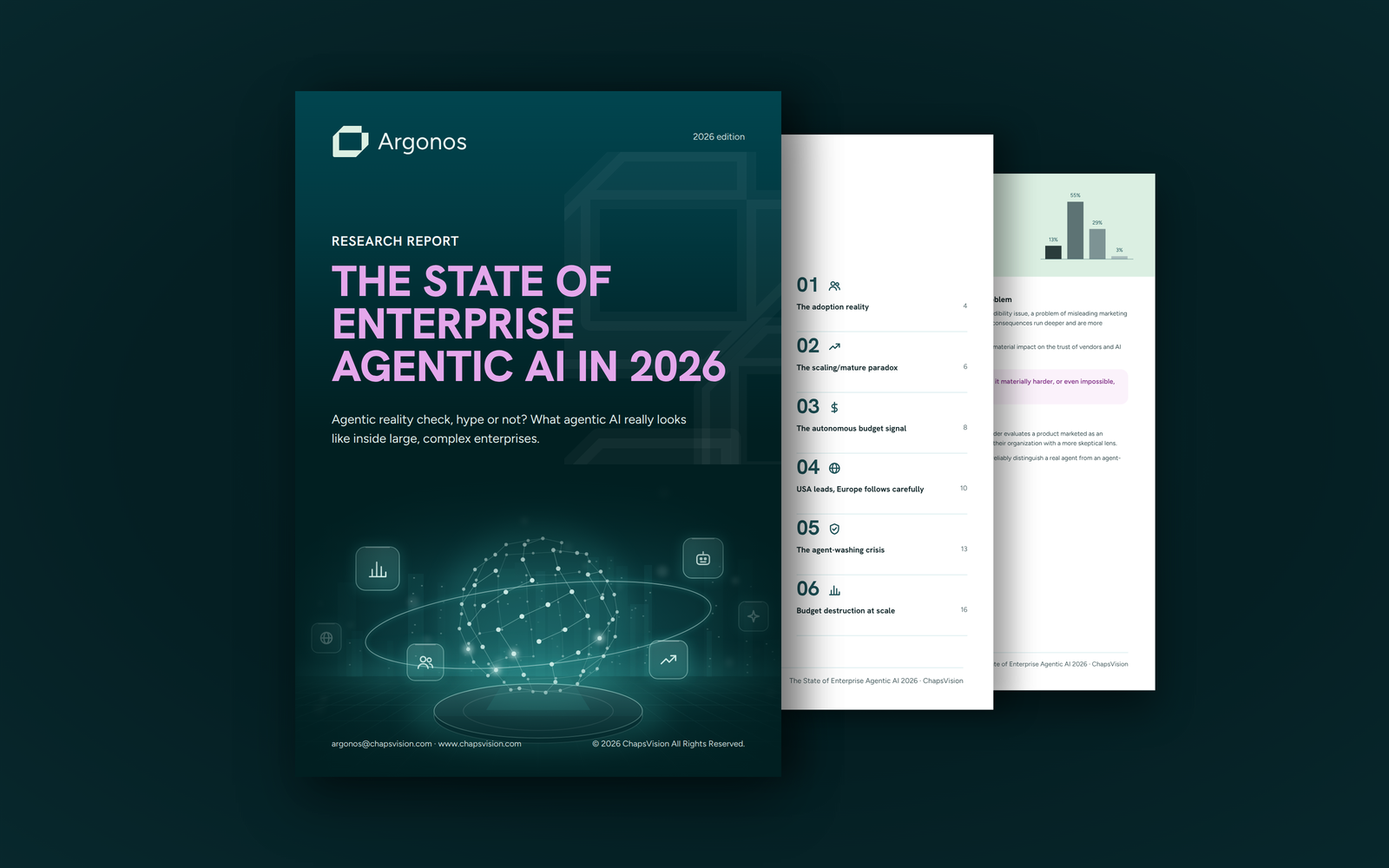
Explore the state of enterprise agentic AI in 2026 through insights from 740 senior executives, uncovering the gap between AI hype and real-world adoption in complex enterprises.

Marks products with independent analyst recognition (Gartner, Forrester).
See how Argonos connects enterprise knowledge, work, permissions, and rules to power enterprise search, agents, and governed execution.
Explore the platform Context Engineering
Give agents the right context to act on
 Enterprise Search
Find knowledge across every system
 Workflow & Process Automation
Take the manual work out
 Compliance & Audit
Stay audit-ready by default
 Agentic AI
Build and govern your agents
 AI Governance
Control what your AI can do
 Translation
 you can trust
Get an exclusive first look at the complete operational surface for humans and agents to work together on your most critical systems.
Reserve your seatDiscover how to move beyond AI copilots to Operational AI that connects enterprise knowledge and delivers trusted, governed insights.
Get the guideSee how Argonos connects enterprise truth, AI workers, data preparation and operational control.
Explore the platformWhite paper
Explore the state of enterprise agentic AI in 2026 through insights from 740 senior executives, uncovering the gap between AI hype and real-world adoption in complex enterprises.
We will send the document to your email address.
The enterprise AI conversation is saturated with superlatives. “Agentic AI” has become the defining term of 2025–2026, promising a future where autonomous digital workers independently pursue goals, orchestrate complex workflows, and transform business operations. Venture capital is pouring in. Vendor marketing has reached a fever pitch. And yet, when we ask 740 senior executives from companies generating $1B–$20B+ in annual revenue what agentic AI really looks like inside their organizations, a very different
picture emerges.
This research was designed to cut through that noise to establish, with rigorous survey data, where the enterprise market truly stands on its journey toward agentic AI. What we found confirms some suspicions, challenges others, and surfaces a set of structural challenges that the vendor community and enterprise leaders alike must confront honestly.
51% of respondents report to have AI agents in live production environments. On its face, a stronger adoption signal than many anticipated, but the reality of these deployments tells a different story. Only 24% have deployed anything that qualifies as a true agent (autonomous task execution and tool use or multi-agent collaboration), and only 10% have deployed true agentic AI capabilities. The majority are operating assistants and workflow-guided AI — sophisticated tools, but not the autonomous agents the market is promising. This misunderstanding of agentic AI is made worse by the second key finding: pervasive agent-washing.
84% of enterprise leaders encounter products marketed as “agents” that are, in reality, sophisticated chatbots. This is not a minor nuisance; 88% report it has negatively affected their trust in AI broadly, with 29% saying this has made it materially harder to secure budget for legitimate agentic projects. Market credibility is eroding from within.
The top three barriers enterprises cite are all variants of the same fundamental problem: they cannot trust the outputs. Reliability/hallucinations (43%), security and privacy (42%), and accuracy (40%) dominate. 86% of executives cite one of these three barriers as a top blocker to implementation. Enterprises are not being held back by a lack of willingness to invest; 71% say they are investing “a lot.” They are being held back by agents that behave unpredictably.
The question of what agents know is as critical as how they behave. Only 19% of respondents use basic/manual knowledge management — most have progressed to some form of RAG architectures. But most of these organizations are still using naïve RAG and lack the advanced agentic RAG knowledge fabric needed to handle agentic complexities and tackle high-value use cases. The result is that the knowledge pipeline is leaking at multiple points: 38% struggle with data that doesn’t update, 38% fear giving agents access to sensitive or regulated data, and 31% are hamstrung by data silos. Not all RAG is created equal, and agents are only as good as what they know.
Andrej Karpathy was right: this is the decade of agents, not the year. The foundations for transformative agentic AI are being laid right now: investment is high, production deployments are growing, and the capability roadmap is clear. But the structural challenges around trust, governance, and knowledge are deep enough that widespread, high-value, autonomous agent deployment is a multi-year journey. Enterprises that build the right foundations today will be positioned to capture disproportionate value when the technology matures.