

Workflow and Process Automation
Trusted agents, real workflows
Move past rule-based RPA to agentic AI workflows that carry a process end to end, across every system it touches. Argonos grounds each agent in your enterprise knowledge, runs the sequence across PLM, ERP, QMS, or case management, and stops for human approval wherever you set the line. Every step is permissioned, sourced, and traceable.
- 3-5+ hours saved per engineer, per week (Cummins)
- 15% faster time to market (Forrester TEI 2026)
- 25X time-to-delivery gain (Forrester TEI 2026)
Workflows and process Automation
-
Find
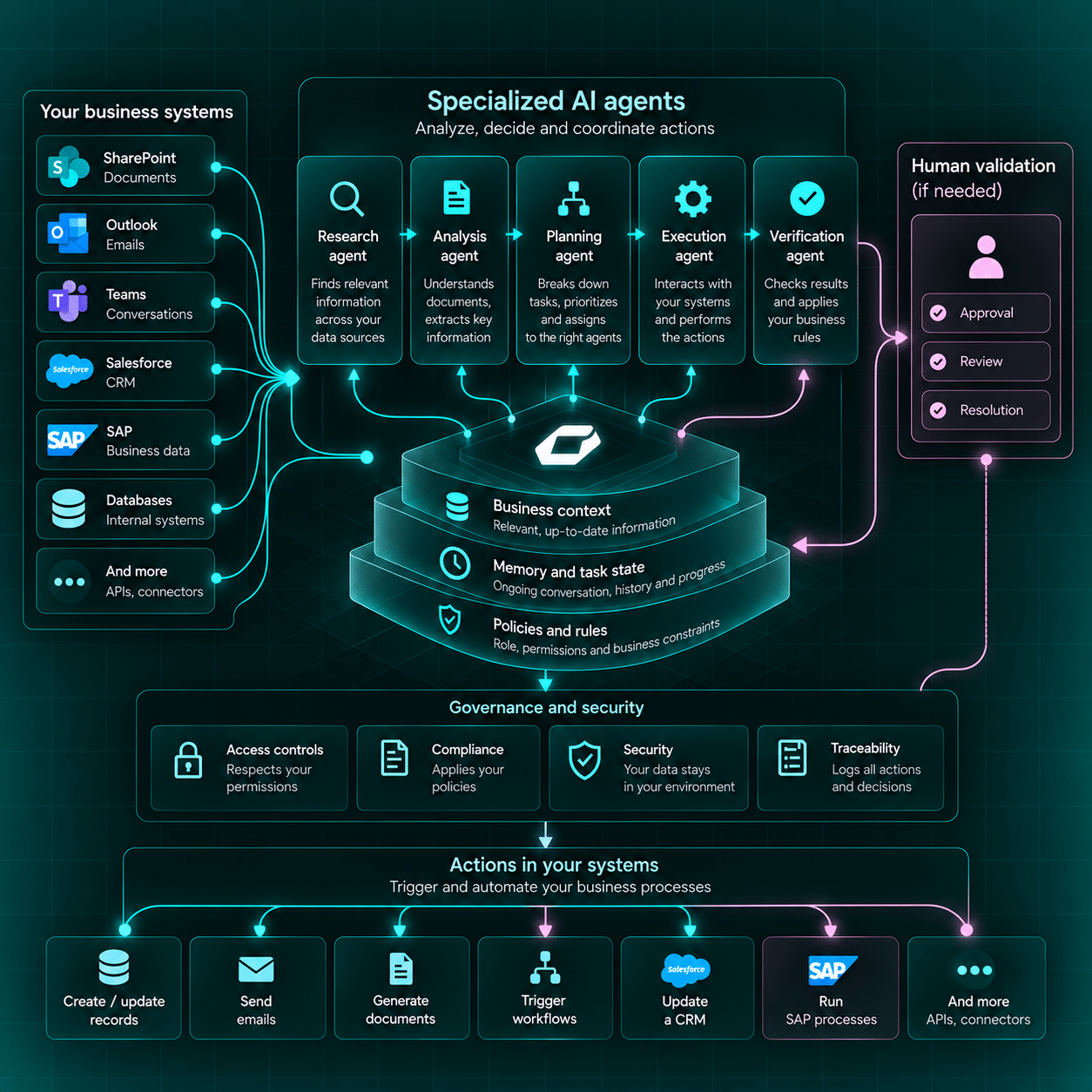
Argonos is connected to your systems of record alongside your documents and collaboration tools. Every workflow builds the required context for the specific case.
-
Decide
Argonos checks every output against the source records before the workflow moves forward. A missing approval or an out-of-date revision stops the sequence, right there.
-
Act
Agents run where your teams already work, on the same permissioned index, approved by your team, or completed by an agent where you’ve allowed it.
-
Trust
Each workflow records what it read, what it produced, and who signed it off, all within your rules.

The work rules-based tools could never do
Argonos runs the processes your industry is built on, across every system they pass through

Change and quality workflows
An engineering change or a supplier issue sets off the same sequence every time. Argonos runs it across PLM, ERP, and the quality system, and routes the packet with records attached.
- The review packet assembled from PLM and ERP
- The machine history and design references a CAPA needs
- The returned part, supplier, and build evidence assembled
- The design history and approvals a filing needs

Quality events and submissions
A deviation, a site opening, a filing, each pulling from LIMS, QMS, and the eTMF, records tied to the version in force. Argonos runs it to the point your quality system allows.
- CAPA closure: the evidence behind an effectiveness check
- Site activation: the documents, contracts, and training a new site needs
- Submission sections: the source documents drafted into the filing
- Complaint investigation: the batch history and prior events, written up

Program and proposal work
Proposals, engineering changes, fleet campaigns, each pulling records across programs, systems, and decades, same part, three different numbers. Argonos runs it as far as your program allows.
- Proposal compliance: the response built against each requirement in this RFP
- Change proposal: the records a cost and schedule case rests on
- Service bulletin: the parts, labour, and downtime a campaign takes
- Obsolescence: the qualified alternates and the programs a change touches

Client, credit, and compliance work
Client work, same handoffs each time, across CRM, core records, correspondence. Argonos runs it as far as your controls allow.
- Periodic review: the file, the screening, and the recommendation on this client
- Credit memo: the exposure and covenant history drafted into the file
- Loan file: the third-party reports and conditions a closing still has open
- Complaint response: the correspondence, prior outcomes, and the reply drafted
They Trust Argonos





Workflows and Process Automation
Agentic AI workflows: why most pilots never reach production, and what the ones that do have in common
An agentic AI workflow that runs in a demo and one that runs on a live engineering change order are not the same object at all. The first just needs a good model. The second needs grounding in enterprise knowledge, inherited permissions, a full audit trail, and a person somewhere in the loop. This article walks through those four conditions, with an example pulled from manufacturing.
An agent that answers and an agent that acts
A design change that touches four systems
A design change lands on a part used across four programs. Somewhere, an engineer just inherited three days of work, tracking down:
- Affected assemblies, from the PLM
- Supplier and cost impact, from the ERP
- Prior field failures, buried in the service records
- The certification requirements the change has to clear, sitting in a document share nobody indexed properly
Where the knowledge already sits
The knowledge exists, all of it, but it’s spread across five systems that cannot agree on a part number. At Cummins, engineers had a name for this kind of work: they called it “doing archeology.”
The same process, run end to end
This is exactly the process an agentic AI workflow is built for. AI agents plan the sequence against the actual case, retrieve the records, draft the packet. Then they check their own output and stop, right before the finish line, for the change board’s approval. That last stop is what separates agentic AI from the productivity assistants most companies have already rolled out. A copilot answers a question. An agentic workflow carries a process from the first record all the way to a signed-off result.
Why the pilots stop before production
Most organizations have run at least one pilot by now, but few have gotten one into production, for reasons that are consistent across industries. The model is never one of them.
Four reasons generic AI agents fail in production
What a scripted demo does not show
Generic agents look great in a scripted demo, because the demo controls every input. Live data does not extend the same courtesy: four failures show up the moment an agent touches real enterprise systems, and none of them has anything to do with how smart the model is.
Grounding
The first is grounding. Left to its own devices, a large language model (LLM) plans and acts from its training data. Give it a part number and nothing else, and it will happily produce a plausible revision history that has no relationship whatsoever to the one sitting in the PLM. Retrieval-augmented generation fixes this by pulling from the organization’s own systems before the agent reasons at all. Agentic RAG pushes further still: the agent decides what to retrieve at each step of the plan.
Access
The second is access. An agent running on a service account sees whatever that service account can see, nothing more. In a company where engineering, procurement, and quality each run their own permission model, that’s not a minor gap: it’s a data-protection incident waiting to happen. The agent needs to inherit the same role-based and attribute-based permissions already enforced across the systems it touches, down to the file, down to the row.
Traceability
The third is traceability. An agentic AI workflow that updates a PLM record needs a record of its own doing the updating: what the agent read, what it produced, and who signed off. Without that log, an auditor shows up six months later to a changed record with no explanation. In a regulated industry, that’s usually where the project ends.
Scope
The fourth is scope. Developer-facing agent frameworks hand you a toolkit and nothing else, with no knowledge foundation underneath it. Large software vendors hand you agents that work beautifully inside their own suite and stumble the moment they step outside it. Neither one reaches the PLM, the LIMS, or the case-management system where the work that actually matters gets done.
The components of an agentic workflow
The components of an agentic AI workflow are well documented by now. What matters more is how each one behaves on the engineering change described above.
- Planning breaks the process into steps against the case in front of it: which systems to query, in what order, which certification checks this particular part actually needs. If the part carries a different number in the ERP than in the PLM, the plan adapts instead of failing.
- Tool use means the agent acts on systems through governed connectors, never through screen scraping. It queries the PLM, reads the QMS, drafts inside the document system, updates the ticket. Argonos does this across 200+ prebuilt connectors and 300+ formats, legacy CAD records and inconsistent part numbering included, since most manufacturers are still carrying both.
- Memory holds the case context across the whole sequence: the part identity resolved at step one is still the same part at step six, whatever each system decides to call it.
- Reflection checks every output against the source records before the workflow moves forward. A missing approval or an out-of-date revision stops the sequence right there, before either one makes it into the field.
- Orchestration coordinates several specialized agents on one process: one resolves the part identity, a second assembles the impact analysis and the affected requirements, a third drafts the review packet with every figure linked back to its source record. The orchestrator assigns the steps, resolves the hand-offs, and routes the finished packet to the change board.
This is also where human oversight actually lives, in the orchestration layer. A single agent trying to do everything is hard to govern and easy to break. Several narrow agents, each with a defined role and bounded permissions, are easier to test, easier to audit, and, when something needs to change, easier to replace.
Human-in-the-loop as a design decision
Where the approval step sits
The change board reviews the packet, edits it if it needs editing, and approves it before the agent updates the PLM and notifies the affected programs. That pause isn’t a limitation bolted on for comfort. It’s where the whole workflow’s value actually sits.
Analytical work, not physical control
Agentic AI in enterprise operations is built for analytical and operational work: case preparation, document assembly, cross-system updates, periodic controls, batch and scheduled processing. It is not a substitute for autonomous decision-making on outcomes that carry real stakes. Where the line falls, between what an agent finishes alone and what stops for a person, gets set per workflow. It depends on the task, the stakes, and how much trust the organization has actually built up, and that line moves as trust grows.
Which matters for how the platform gets scoped in the first place. The agent prepares; a person decides, wherever the stakes call for it, and the workflow keeps running without AI if it has to. A low-risk, well-defined step completes straight through. A step that touches certification, a customer commitment, or a regulatory filing stops for sign-off, no exceptions.
Sovereignty and deployment control
Sovereignty belongs in this same conversation. Hosting in Europe isn’t sovereignty. Control is: over where the platform runs, which models it uses, who can touch the data, and how every action gets logged. Argonos deploys on your own cloud, in a data center, or on-premise, with your choice of models and no vendor lock-in. For regulated institutions across Europe and North America, that control has stopped being a late-stage security question. It’s increasingly a condition of the procurement itself.
Measuring the return on the process
What Cummins reports
Cummins has been an Argonos customer since 2025, running the platform as its knowledge foundation across engineering. Their reported results, by order of magnitude:
- Three to five hours saved per engineer, per week
- 15% faster time to market
- A fivefold improvement in cross-program engineering answer quality
- 15 to 20% compliance savings
- 20% less rework
These are client-reported results for one named customer, not the composite figures cited in the Forrester study above, which model a hypothetical composite organization. Cummins started with search and knowledge work; the same foundation now runs the workflows described in this page.
A pilot proves this on one process before it becomes a program: pick a single scoped workflow, measure it against this organization’s own baseline, and let that result decide whether to expand.
The foundation underneath
The fourth is the one that actually turns a pilot into a program. One governed foundation runs every agentic workflow. The connectors, the permissions, the ontology, the index, all of it built once for the first process, all of it reused for the next. The second workflow ships faster than the first. The fourth, faster than the second.
That foundation is Sinequa by Argonos, named a Leader in the SPARK Matrix for Enterprise Agentic AI Platforms, Q4 2025, and a Representative Vendor in Gartner’s. Two decades of knowledge engineering sit underneath every agent the platform runs.
What separates a workflow in production from a pilot
The question an operations or engineering leader should ask of any agentic AI workflow was never whether the agent is smart. It’s whether the agent is grounded, governed, traceable, and stoppable. The organizations that have answered those four questions are the ones running agentic AI workflows end to end today. That’s what separates a workflow in production from a pilot that never left the deck.