


Compliance, Financial Crime & Controls
Regulatory compliance, powered by governed AI
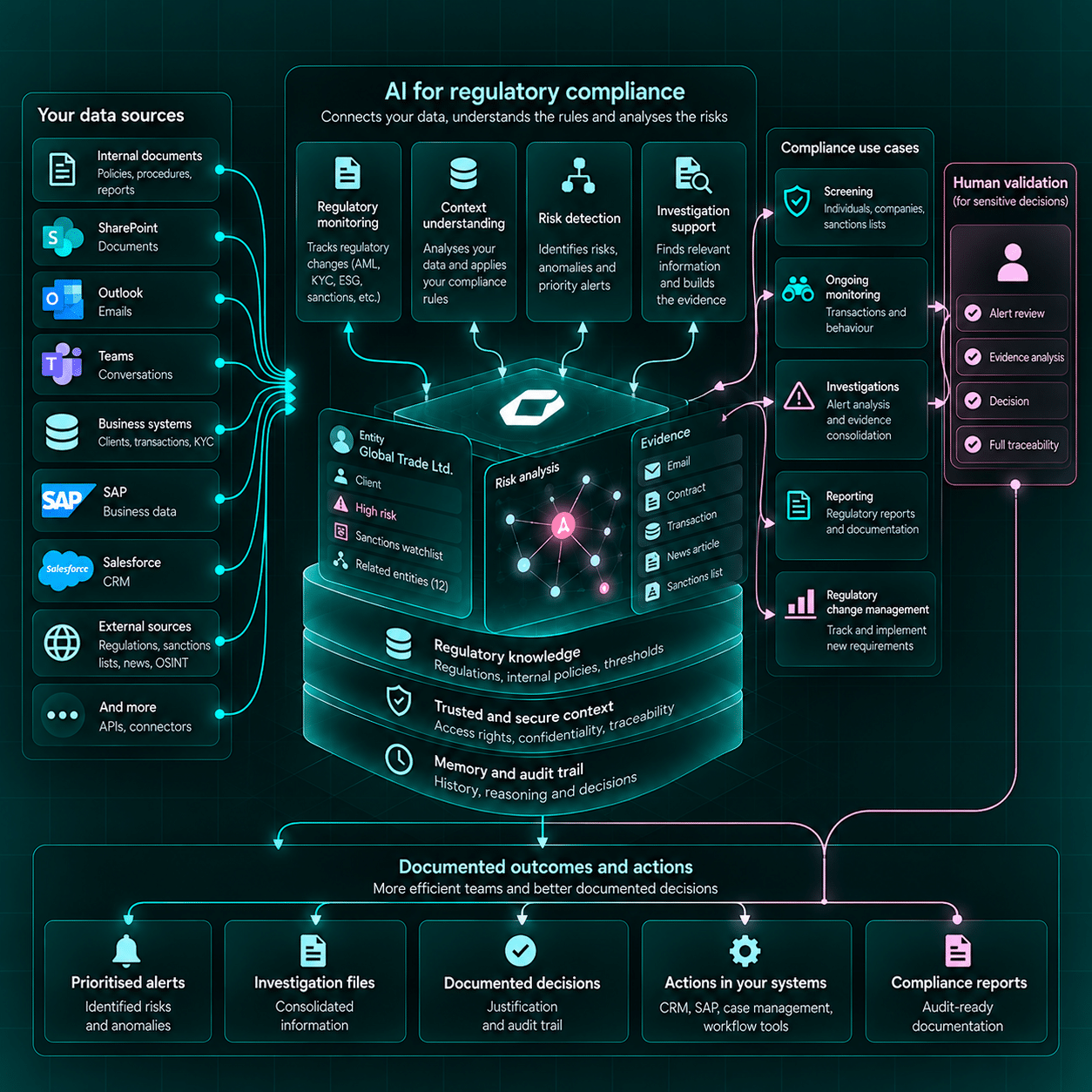
Regulatory requirements differ across banking, insurance, asset management, private equity, and public-sector oversight, but compliance and control needs overlap: identify risk, investigate alerts, verify information, document and justify decisions. The data and evidence stay fragmented across specialist systems, internal sources, and documents. Argonos connects and governs it in one shared foundation, so teams build context once, reuse it across processes, and decide faster, traceably.
Trusted by banks, insurers, and public authorities
Already running in production for mission-critical work, not a pilot in a sandbox




Use cases shaped by sector, mandate, and decision accountability
-
Banking
AML/CFT and transaction-monitoring alert prioritization and investigation, sanctions and PEP screening, KYC/KYB and enhanced due diligence, beneficial ownership analysis, network and fund-flow analysis, STR/SAR preparation, and DORA and NIS2 control evidence and audit readiness.
-
Insurance
Claims and policyholder 360° views, organized claims fraud and provider-network analysis, SIU investigation management, life-insurance AML/KYC, claims-leakage reduction, and conduct and complaints monitoring.
-
Asset Management & Private Equity
Investor onboarding and periodic KYC review, beneficial ownership analysis, suspicious fund-flow detection, market-abuse surveillance, mandate and conflicts-of-interest monitoring, and consolidated reporting across funds and vehicles.
-
Public Sector Financial Investigation & Oversight
Risk-based supervision, STR/SAR triage and cross-report linkage, financial investigations, asset tracing, network and fund-flow analysis, case prioritization, and evidence-based decision support for public authorities.
-
Internal Control & Audit
Continuous control monitoring, control testing, evidence collection, recurring-finding analysis, remediation tracking, audit trail review, and audit readiness across business processes and regulated activities.



Where to start?
Three entry points make the strongest case for initial investment. Alert and case investigation, to reduce backlogs and accelerate well-supported decisions. Customer and entity intelligence, combining 360° views with network and fund-flow analysis to reveal hidden relationships and exposures. Control, evidence, and remediation management, to keep the audit trail continuously available rather than reconstructing it when an audit begins.

The foundation beneath find, decide, act
Argonos powers the find-decide-act cycle compliance teams already run. It connects fragmented systems and data through a shared, adaptable semantic model, and keeps data, evidence, and decisions traceable end to end. Teams find the relevant records, decide with the full context in front of them, and act, search, investigate, and document, from one reliable business context instead of reconstructing it manually across multiple tools and sources.

What's actually holding compliance teams back
“We spend more time finding information than analysing it.” Most teams have already added screening tools, transaction-monitoring solutions, and GRC platforms, but each addresses only part of the decision lifecycle. Analysts still spend significant time manually searching, reconciling, and rebuilding context across systems, documents, and data sources. The workflow breaks when the same customer, entity, or relationship is represented differently across systems, precisely where the stakes are highest: closing an alert, resolving a sanctions match, or confirming that a control was effective. A missed risk can create regulatory exposure; an unsupported conclusion may be impossible to defend later.

Sovereign by design, with AI that stands up to scrutiny
Deployment stays under your control, on-premises, hybrid, or controlled SaaS, with data residency, access rights, sources, processing steps, model and prompt versions, user actions, and decisions governed and traceable. Agents support investigation, summarization, and drafting, while sensitive or consequential actions remain subject to human validation. Sovereignty means concrete control over where the platform runs, which models and agents are used, where data is processed, and who can access it, not just a claim on a slide.

Regulatory monitoring, AML, and case investigation
Argonos helps AML teams connect regulatory requirements, internal policies, and case history to ongoing investigations. It supports risk-based alert prioritization and sanctions or adverse-media review. For document-heavy processes such as enhanced due diligence or credit application analysis, Argonos RAG capabilities analyze large document sets, surface relevant information, and make the resulting data directly available for structured analysis, investigation, and reuse.

AI-enabled, human-controlled
AI in Argonos goes far beyond drafting or conversational assistance. It can extract and structure information, summarize large document sets, identify patterns and anomalies, prioritize alerts and cases, support investigations, generate recommendations, and draft reports. These capabilities operate on governed, traceable data and business context, while sensitive or consequential decisions remain subject to human validation.

Who this is for
Built for the people accountable for the decision

The people investigating, closing, escalating, or validating cases and controls, under pressure to move faster without compromising decision quality, traceability, or evidence.
Compliance
Understanding regulatory compliance in the age of AI
What regulatory compliance means, and where the cost of getting it wrong actually comes from
Regulatory compliance is the set of actions an organization takes to meet the laws, regulations, and standards that govern its business. For banks, insurers, asset managers, and public authorities, that list has grown heavier every year:
- FATF recommendations and the Wolfsberg Principles, which shape how anti-money laundering (AML) and counter-terrorism financing (CFT) programs are built
- OFAC and EU sanctions regimes
- DORA and NIS2, for operational and cyber resilience
- GDPR, for data protection
- The EU AI Act, for the artificial intelligence systems compliance teams themselves now rely on
Supervisory expectations vary by jurisdiction, from FinCEN and the FCA to the ACPR and BaFin. The underlying discipline stays the same: demonstrate that the control operated, not just that a policy exists.
Where the evidence actually lives
The difficulty rarely comes from a missing regulation. It comes from where the evidence to meet it actually lives. Customer, transaction, screening, and ownership data sit in different systems, under different identities, updated at different speeds. Regulatory intelligence, the ongoing tracking of what’s changing and what applies, gets built manually, regulation by regulation, team by team. Compliance monitoring, in most organizations, is still a patchwork of point tools: a screening engine here, a case-management system there, a spreadsheet holding the parts nothing else covers.
The result is a rising cost of non-compliance. Fines are only part of it; remediation programs, external consultants, emergency recruitment, growing backlogs, and the slow erosion of customer and regulator trust make up the rest.
The cost of non-compliance, and what actually drives it
The recurring cost drivers
The cost of a missed or late compliance decision rarely shows up as a single line item. It accumulates across several recurring drivers: regulatory fines and legal exposure, remediation programs and external consulting fees, additional recruitment and overtime to work down a growing backlog, and the slow accumulation of manual reconciliation across systems that were never designed to talk to each other.
What the cost looks like, sector by sector
- Banking: a fragmented view of customer, transaction, and screening data means alerts get reviewed late or incorrectly, and decisions can’t be reproduced when a regulator asks why they were made.
- Insurance: claims get delayed, overpaid, or wrongly rejected because policy, claims, and supporting evidence are split across separate systems, and organized fraud networks stay invisible because claimants, accounts, providers, and intermediaries are never connected.
- Asset management: high-risk investors or counterparties go unidentified because ownership, fund-flow, and reference data are inconsistent, and breaches surface only after the fact, once controls built on disconnected datasets have already failed to catch them.
- Public sector: suspicious transaction reports and investigations go unlinked because names, accounts, and entities are recorded differently across agencies, and assets move before freezing or seizure action can be taken.
- Internal control and audit: controls get marked complete without sufficient evidence, and the same findings recur because ownership, testing results, and remediation actions are spread across disconnected tools. That’s usually what a failed audit looks like from the inside.
The recurring pattern across every sector is rarely that the information doesn’t exist. It’s that the information is fragmented, inconsistent, outdated, or inaccessible at the moment the decision has to be made.
How AI powers the compliance function
Unifying the data before adding another tool
AI-powered compliance work starts by unifying that fragmented data rather than adding another tool on top of it. A governed platform connects internal systems, regulatory sources, and case history into one searchable layer, so an analyst investigating an AML/CFT alert, screening a sanctions match, or preparing a suspicious activity report gets the full context in one place, not five separate logins. This is what distinguishes AI-powered compliance monitoring from traditional rule-based alerting: the system doesn’t just flag a match, it retrieves and explains the regulatory basis, the internal policy, and the relevant case precedent behind it, with every answer traceable back to its source.
Where each sector starts
The pattern holds across every regulated sector, though the entry point shifts with what the buyer is accountable for:
-
- Banking compliance teams prioritize alert and case investigation, sanctions and PEP screening, and customer and entity 360° views that surface hidden relationships and financial-flow patterns.
- Insurance teams prioritize claims and policyholder 360°, organized-fraud and provider-network analysis, and faster SIU investigation cycles.
- Asset managers prioritize investor and beneficial-ownership intelligence, market-abuse surveillance, and mandate compliance across fund structures.
- Public-sector supervisors and financial-intelligence units prioritize risk-based supervision, cross-report linkage, and financial investigation and asset tracing.
Internal control and assurance teams prioritize continuous control monitoring, evidence collection, and remediation tracking, closing findings before they recur.
Screening, due diligence, and false positives
Financial crime compliance benefits particularly directly. AML compliance work, sanctions and PEP screening, and know-your-business due diligence all depend on connecting identity, transaction, and relationship data that typically sits in separate systems under separate identifiers. AI-grade search and retrieval reduce false-positive workload not by suppressing alerts, but by attaching the relationship, historical, and screening context an analyst needs to close a low-risk match faster and escalate a real one with confidence.
The same foundation extends to DORA and NIS2 readiness, where incident records, third-party risk registers, and resilience-testing evidence need to be findable and defensible on demand. It extends to audit readiness generally too, where evidence assembled as a byproduct of the daily workflow replaces the scramble to reconstruct it after the fact.
Compliance management software and GRC platforms
Compliance management software has traditionally managed workflow, policy, and reporting. What it hasn’t done well is bring AI-grade search and reasoning across the full body of regulatory and internal content an organization holds. GRC platforms track controls and policies; they don’t reconstruct the case context an investigator actually needs at the moment of decision. That gap, between managing the compliance process and actually understanding the regulatory and operational reality behind it, is where AI-powered compliance platforms now sit.
What compliance teams have already tried
Most organizations arrive at this problem having already tried to solve it:
- Point solutions for screening, fraud, or case management
- Data lakes and warehouses, BI dashboards, workflow tools, and RPA scripts
- Outsourced analysts and temporary remediation teams
- GRC and audit platforms to track controls and evidence
The results tend to be limited for a consistent set of reasons. Each initiative usually improves one stage of the process rather than the full decision lifecycle. Systems still use different identities, data structures, and business definitions for the same customer or the same transaction. Dashboards show indicators without always providing the full case context behind them. Workflow tools move a task from one queue to the next without necessarily connecting the underlying evidence. Data lakes centralize information without making it operational, explainable, or usable by the investigator who actually has to act on it. And investigation outcomes rarely feed back into the rules, controls, or detection models that generate the next alert, so the same gaps keep reappearing.
What fills the space between these tools is usually more manual work: unofficial Excel trackers, analyst-owned macros and scripts, shared mailboxes, screenshots used as audit evidence, personal watchlists, duplicate case files, and a dependence on a small number of senior employees who know how the system really works. The workaround isn’t a technology failure so much as a symptom; organizations have added tools around the problem without building a shared, governed information foundation underneath them.
AI compliance: when the AI itself must meet the rules
The EU AI Act and AML scoring systems
The EU AI Act changes the equation for any organization building or deploying AI systems, including the ones used for compliance and risk work itself. Regulation (EU) 2024/1689 applies directly across the EU, so there’s no jurisdictional variation in the rule itself. What remains open to interpretation is whether a given AML scoring or alert-prioritization system falls under Annex III as high-risk, and how much human review sits between its output and the filing. Recital 58 of the Act specifically excludes fraud-detection AI systems in financial services from the high-risk category, which is a relevant anchor for how many AML tools are likely to be classified, though the analysis still depends on the specific use case.
Organizations shouldn’t wait for that question to be fully resolved before building the traceability and human-oversight controls a high-risk classification would require anyway. Those are the same controls a defensible AML program needs regardless of how the Act is ultimately applied to it.
Grounded, traceable, and governed by construction
Meeting that obligation means the AI compliance platform has to be grounded, traceable, and governed by construction, not adapted after the fact.
- Grounded means every answer is generated from the organization’s own data, with source attribution, rather than from general-purpose world knowledge with no business context.
- Traceable means every source, transformation, access, and decision the system touches is logged and auditable, so an organization can reconstruct not just what an AI system concluded, but why, and on what evidence.
- Governed means access follows the same role-based and attribute-based permissions already enforced across the organization’s systems, and sensitive decisions stay under human control, with AI supporting investigation, drafting, and summarization rather than making the final call.
The scope an agent should be given
The language around agentic AI in compliance is easy to overstate. Agentic AI should only be used where agents have a defined role, bounded permissions, controlled data access, traceable actions, and human oversight, not as a stand-in for autonomous decision-making. The same applies to how the platform gets scoped: built for batch, scheduled, event-driven, and near-real-time analytical workflows, not positioned as an instant payment-authorization engine or a fully autonomous compliance decision-maker.
Sovereignty, made concrete
Hosting infrastructure in Europe isn’t, by itself, sovereignty. Real sovereignty means controlling:
- Where a platform runs: on-premises, hybrid, or a controlled SaaS environment
- Which models it uses, and whether that choice can change without vendor lock-in
- Who can access the data, and under what conditions
- How every action taken by a person or an agent gets logged for later review
For regulated institutions operating in the EU, UK, and US alike, that concrete definition of control matters more than where a data center happens to sit.
The word resonates differently depending on the buyer. It’s highly relevant for public authorities, banks, insurers, and other regulated organizations, particularly in Europe, where deployment control, data residency, and reduced dependency on public cloud services are increasingly part of the procurement conversation itself, not an afterthought raised late in the deal. For institutions with a lighter regulatory footprint, the same principle still applies, but the emphasis shifts toward auditability and model control rather than physical location.
What changes, in time, evidence, and confidence
The business-case assumptions to validate in a pilot
Organizations evaluating a platform like this are right to ask for numbers. The figures below are initial business-case assumptions to validate during discovery and pilot phases, not delivered customer results or contractual commitments:
-
- A 20 to 40 percent reduction in time spent searching for and reconciling data
- A 15 to 30 percent reduction in end-to-end investigation or case-handling time
- A 10 to 25 percent increase in cases processed per compliance FTE
- A 30 to 50 percent reduction in audit-evidence preparation time
Reductions in false positives or detection-rate improvements in particular should never be committed to before the underlying rules, data, typologies, and models have been tested against real case data.
An illustrative capacity model
An illustrative capacity model helps make this concrete: if 100 analysts each save one hour per working day across 220 working days, the organization releases approximately 22,000 hours of annual capacity, equivalent to roughly 14 full-time employees at 1,600 productive hours per FTE. At an illustrative loaded cost of 60 euros per hour, that represents approximately 1.3 million euros of annual capacity value. This is a model to validate against a client’s own baseline during a pilot, not a promised outcome.
Confidence, explainability, and defensibility
The value that doesn’t show up on a chart matters just as much to the people accountable for the outcome:
-
- Confidence that a decision was made on complete, current, and authorized information
- The ability to explain, months later, why a signal fired, and to reproduce the evidence that was available at the time
- Less dependence on a small number of people who know how the system really works
- For the executives who ultimately answer to a board, a regulator, or a court: defensibility. Proof that controls operated, evidence was reviewed, responsibilities were clear, and remediation was followed through
Meeting both obligations with one platform
The organizations that manage this well don’t treat regulatory compliance and AI compliance as separate initiatives with separate budgets and separate vendors. The same platform capabilities, grounded retrieval, governed access, full traceability, and human oversight, serve both purposes at once. The AI that helps a compliance team find the regulation, monitor the alert, and prepare the audit response is held to the same standard the regulation itself now demands of AI. That alignment, rather than a patchwork of point solutions bolted together after the fact, is what lets compliance, risk, and technology teams meet a growing body of regulation with confidence, whether the case in front of them is an AML alert, a claims-fraud investigation, an investor review, a supervisory inspection, or an internal control finding waiting to be closed.